Imagine spending six months producing a life-saving drug only to learn that one tiny dust particle caused a wreck. Controlled environments have invisible enemies eager to destroy million-dollar research endeavors and imperil patients. Because of this harsh reality, the medicine, electronics, and biotech industries must create military-grade barriers at every entrance to prevent contamination.
What Are Air Shower Interlocks?
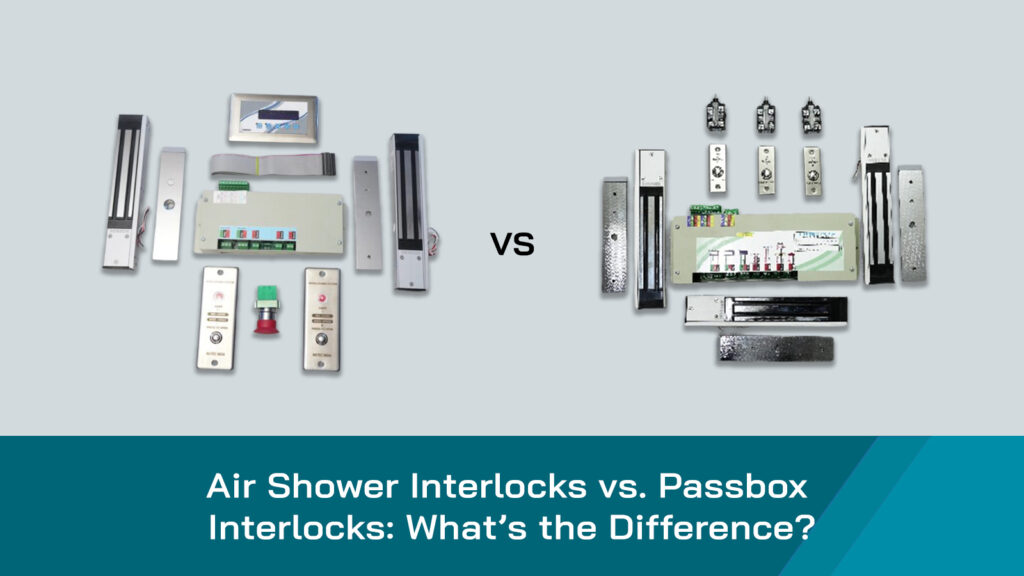
Air shower interlocks are advanced devices for controlling contamination that are made to clean people. These interlocking systems use fast-moving jets of air to get rid of particles from persons who are entering clean areas.
Two doors that lock together and can’t be opened at the same time are usually part of an air shower for clean room use. People go into the chamber, and air that has been filtered by a HEPA filter blows at rates of more than 20 m/s to get rid of dirt and germs on clothes and skin.
The interlock mechanism makes sure that the cleaning cycle is done correctly. These devices can reduce particle count on individuals by 95%, eliminating cross-contamination, according to studies.
What Are Passbox Interlocks?
Air showers blast pollutants away, while passbox interlocks don’t. Passive isolation is used instead. Small transfer chambers create sterile passageways for transporting items between hazardous locations.
Pass boxes use clever containment instead of forceful cleaning. These airlocks maintain pressure differences due to strict “one door only” electronic or mechanical interlocks. During transfer cycles, some advanced machines use UV sterilisation to clean materials longer.
Key Differences Between Air Shower and Passbox Interlocks
The main differences are:
- Purpose: Air showers clean people; passboxes move things from one place to another.
- Size: Air showers can fit people; passboxes can fit smaller things.
- Air velocity: To remove particles, air shower requirements call for higher speeds.
- Cycle time: Air showers work for 10 to 15 seconds, whereas passboxes let you change the timing.
- Zone selective interlocking: Different processes depending on how clean things need to be.
Air showers employ high-speed air streams to actively clean things, while passboxes use isolation and sometimes UV sterilisation to keep things clean.
When to Use Air Showers vs. Passboxes
Choose air showers if people go inside cleanrooms often. They are required in places where drugs are made, semiconductors are made, and biotechnology research is done, where human contamination is a big risk.
Choose passboxes to move materials across areas with different levels of cleanliness. They’re great for moving tiny tools, samples, and supplies without having to relocate people.
As part of their overall plans for controlling contamination, several facilities use both approaches. The kinds of interlocking rely on the rules and needs of the business.
Importance of Interlocks in Preventing Contamination
Both systems depend on interlocking mechanisms to keep the cleanroom safe. These safety features avoid pressure cascades and airflow patterns that control contamination by stopping doors from acting simultaneously.
Working interlocks reduce contamination by 70% compared to systems without them. Regular maintenance makes sure that everything works well and meets all the rules.
Conclusion
Air shower interlocks and passbox interlocks are both important for keeping things clean, although they do different things. Knowing how they are different helps facilities pick the right systems for their needs.
Smart sensors, AI-driven controls, and improved materials improve both technologies frequently. Future technologies will improve ultra-clean conditions in sectors that need them.
Are you ready to improve your processes for controlling contamination? Look into contemporary air shower interlocking systems that are made to be as efficient and compliant as possible. Getting professional advice ensures you choose the best solution for your cleanroom needs.
FAQs
Yes, a lot of places employ both techniques to help manage contamination—air showers for people and passboxes for things.
Monthly mechanical part checks and quarterly air flow performance tests ensure pollution control works correctly.
Electronic systems govern and monitor objects with electromagnetic locks and sensors, while mechanical interlocks employ actual pieces.