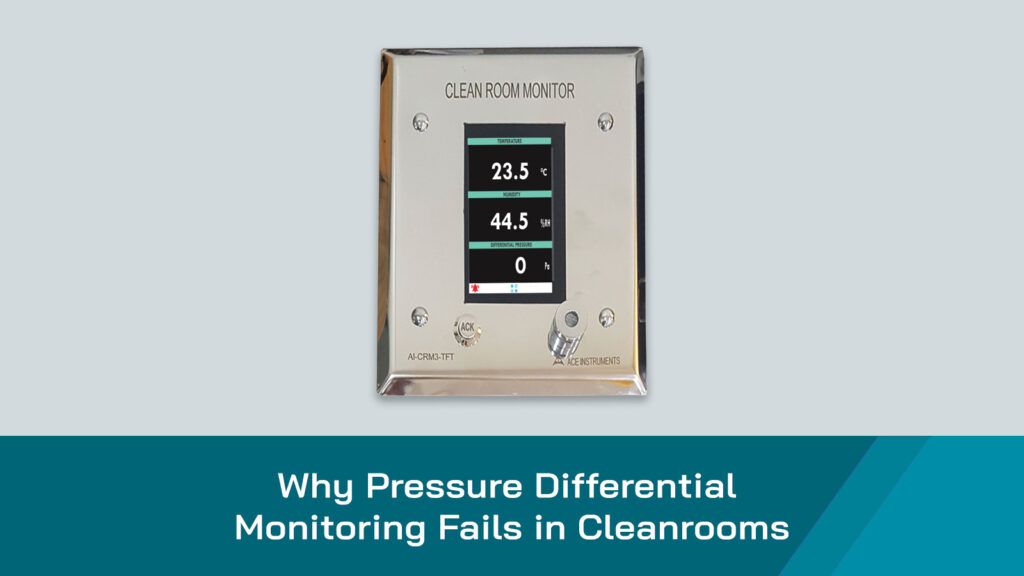
A door that is propped open. A sensor that went off course by two pascals. That’s all it takes for cleanroom pressure monitoring to fail without anyone knowing. By the time you detect, contamination has already happened leading to batch failures, warning letters from the FDA, and costly recalls. The damage is real, and it starts with holes in your monitoring that you didn’t see coming.
The first step to repairing cleanroom pressure monitoring is to figure out where it goes wrong.
Cleanroom Pressure Monitoring and Pressure Integrity Explained
The basic idea of cleanroom pressure control is really straightforward. Clean zones have more pressure than regions next to them that aren’t as clean. This pushes air out, which keeps pollutants from getting into important locations.
Pressure integrity means that the cascade will always be there. GMP Annexe 1 and ISO 14644 require a 5 – 20 Pa pressure difference between designated zones. Your cleanroom prevents contamination when that difference remains. When it doesn’t, the air flow changes and pollution comes right in.
Pressure Failure in Cleanrooms: Root Causes
Pressure failure doesn’t happen all at once very often. It enters through unnoticed operating cracks.
Overfilled HEPA filters, unbalanced HVAC systems that vary airflow rates without notice, and misaligned door gaps or seals slow system performance. When materials or people pass through, pressure drops temporarily. If you don’t keep a tight grip on things, such transient drops turn into long-term failures.
You can prevent all of these issues. Before stopping them, you must know they are there.
Sensor Drift and Alarm Failure: Hidden Monitoring Risks
One of the most significant and least obvious dangers in cleanroom pressure monitoring is sensor drift. As time goes on, piezo-resistive diaphragms get older. Reading changes as you change the mounting position. The pressure builds up unevenly on the membrane. The consequence is readings that seem normal but are off by 1 – 2 pascals, which is enough to make your pressure cascade inaccurate.
The alarm not working makes things worse. When alarm setpoints aren’t checked or calibrated on a regular basis, excursions go unnoticed. People who run the system believe it when it doesn’t tell the truth. The contamination danger has already occurred by the time the deviation shows up in an environmental monitoring report.
Differential Pressure Sensor Calibration: Fixing Accuracy Issues
Zeroing sensors periodically fixes long-term drift. Bi-directional devices that measure -25 to +25 Pa must automatically correct their mechanical zero points every few hours to stay accurate.
Setting calibration intervals should take into account the sensor type, environment, and rules. Not calibrating on time or skipping it doesn’t simply make things less accurate; it also leaves holes in compliance that auditors will uncover.
Cleanroom Pressure Control: From Monitoring to Stability
Installing sensors is just one part of good, cleanroom pressure control. It needs a cascading pressure model, which means that the pressure gets higher as it goes from Grade D to Grade B to Grade A. Interlocked doors, strict alarm setpoints, and connections to Building Management Systems (BMS) or Environmental Monitoring Systems (EMS) make up an active, automated defence.
Real-time monitoring with visible and audio alarms makes sure that operators act quickly. Data logging makes it all come together for documentation that is ready for an audit.
Cleanroom Contamination Control and Compliance Risks
Not having enough cleanroom contamination control has direct effects on the law. FDA inspectors have cited facilities for not keeping pressure differences, saying that these problems “may allow the ingress of microbiological contamination.” ISO 14644 and EU GMP Annexe 1 don’t allow optional pressure requirements.
If you lose control, you’ll have to write warning letters, order repairs, stop production, and pay for costly recalls. Cleanroom compliance depends on pressure integrity that is documented and kept up throughout time.
How to Fix Pressure Differential Monitoring Failures: Best Practices
To fix problems with monitoring, you need to use an organised approach:
- Plan regular calibrations of the differential pressure sensor with automatic zero-point correction.
- Map pressure cascades throughout all classified zones and check them during commissioning and requalification.
- Establish defined alarm criteria and regularly test the system.
- Seal any wall holes, door gaps, and HVAC connections.
- Check the pressure measurements at the end of each shift and look into every trip in full.
- Combine monitoring with BMS or EMS for ongoing, centralised control.
Conclusion
You can stop cleanroom pressure monitoring failures from happening. If you calibrate your sensors, follow tight operating rules, and monitor things, your cleanroom pressure control and contamination barrier stay strong. Look at cleanroom digital pressure gauges for reliable pressure measurement.
FAQs
GMP Annexe 1 and other standards require 5-20 Pa between classified locations.
Sensors drift with time, usually by 1-2 pascals, because of ageing diaphragms, changes in mounting position, and long-term pressure exposure.
Yes. Even briefly propping a door can break the pressure cascade and let unfiltered air into important areas. This has been cited as a reason for FDA citations.